The Owl has flown another circuit. A month has passed, and we’ve been out gathering: ideas worth considering, people worth knowing, things worth reading, and a few glimpses of the cultural life unfolding around us.
That was the promise of our first issue—to create a space where curiosity might linger a little longer. With our second issue, we hope habits begin. |
|
| |
|
Our intention is attention: to good ideas and beautiful things, to people doing meaningful work, to questions without easy answers, and especially to one another. Attention, after all, is one of the ways we decide what matters. So here is another small collection of things we think are worth your time. Read what interests you. Follow a link to new patches. Send something along to a friend. And if a sentence, story, person, or idea follows you into the rest of your day, The Owl will have done its work. Happy reading. |
Mark Peres
Founder and Executive Director |
|
|
|
Improvisational Speed
By Mike Skiba |
You would think—by the transitive property of money—that the world’s first trillionaire would have cornered the market on certainty. Yet the same man who believes his robots will make saving for retirement irrelevant could offer only this view from the top: “Success is far from certain. But excitement? Guaranteed.” He said a version of it again after one of his rockets blew up. If certainty were for sale, Elon, of all people, would’ve bought it by now. The rest of us know the feeling. Anxiety about the future has done far more than trickle down. Like the 8th wonder of the world, it compounds. “Go to college, get a job”—try telling that to the class of ’26. “Save for a rainy day”—inflation has brought monsoons.
“Death and taxes”—We’ve got biohackers and administration officials hard at work on those now too.
Let’s not kid ourselves about what we’re really after: knowing how our stories end. A neat, tidy expected value on all our flailing deeds and uncollected dividends. But in the age of “recursive, multiplicable exponentials,” our stories won’t sit still. They keep expanding, squirming, shedding every ending we penciled in and every line we pre-rehearsed, casting us farther and farther from stable ground.
So how do we find our footing?
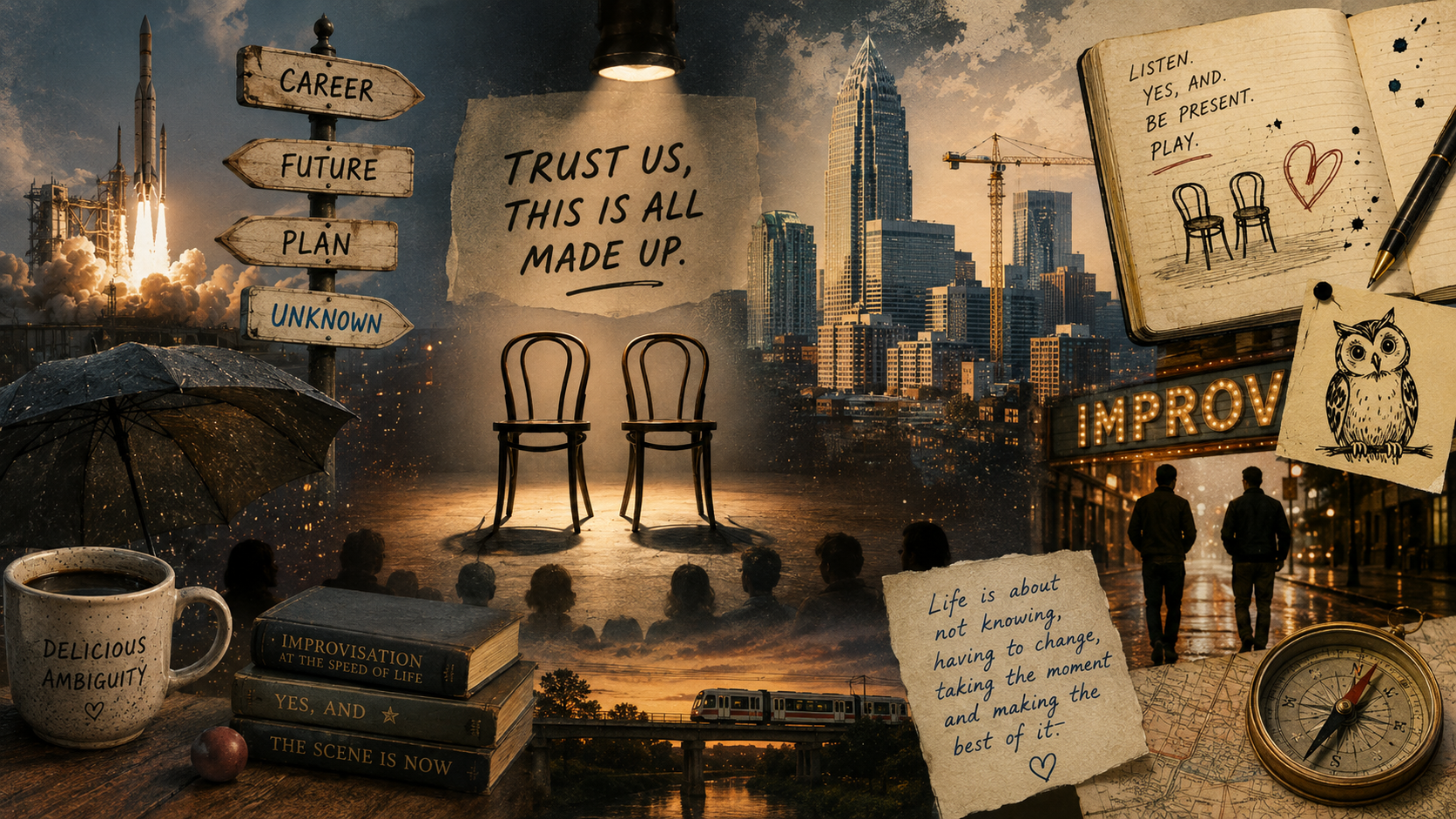
It was Gilda Radner—one of the forebears of American improvisation—who learned the hard way that some stories don’t get clear beginnings, middles, and ends. Near the end of hers, she wrote down something prescient and enduring: “Life is about not knowing, having to change, taking the moment and making the best of it, without knowing what’s going to happen next.” She had a name for it: “delicious ambiguity.” No clutching, no bracing—just a playful openness to whatever’s knocking at your door.
No one lives this ethos better than TJ and Dave, Chicago’s finest long-form improv duo, just in town to headline the Queen City Comedy Festival. Two men. One bare stage. Two chairs. No script. One promise: “Trust us, this is all made up.” Then an hour of theater appears out of thin air. They wrote a book called Improvisation at the Speed of Life, and they’ve spent more than twenty years living its tenets in public: - Everything you need is already there. “You’re in the middle of a scene.” - Everyone knows “yes, and,” but the deeper law is listening. - Care more for the ensemble than the punchline. - The goal is not to be funny or clever. The goal is to be present.
- Keep your sense of play, and you’ll find reverence for the unknown. What works on that stage transfers to our quotidian lives. Whatever scene you’re in right now—the career you’re second-guessing, the conversation you keep not having—the questions are the same: Can you give up the script? Can you listen one percent better? Can you Make Ambiguity Delicious Again?
Maybe Charlotte can be a MADA town. After all, ours is a city of Tiny Money, where everything’s a solid B+—a civic stage somewhere between Broadway’s Spider-Man and two bentwood chairs. It’s a metro ripe for the spirit of improvisation: unencumbered by a demanding past, cheerful about the 150-plus new players joining the troupe each day. Maybe that settles the identity question we keep hiring consultants to answer: Charlotte can be a city whose identity is improvisation itself—a city that finds itself, in other words, in the exact middle of the scene?
Do we try to rewrite our story—muscle it toward an outcome we picked years ago? Or do we do what improvisers actually do: take every crane, every newcomer, every unwritten block as an offer, a gift. Can we live inside the last sentence spoken; and build the next one together?
The Red Line? Someday. South End rent? Up in the air. I-77? Cloudy, with a chance of ... meatballs. Meatballs? Mm-hmm. Sounds pretty delicious to me. |
Mike Skiba works at a regional CPA firm by day. He is an occasional funny guy/AI helper by night. skibastack.com |
|
| |
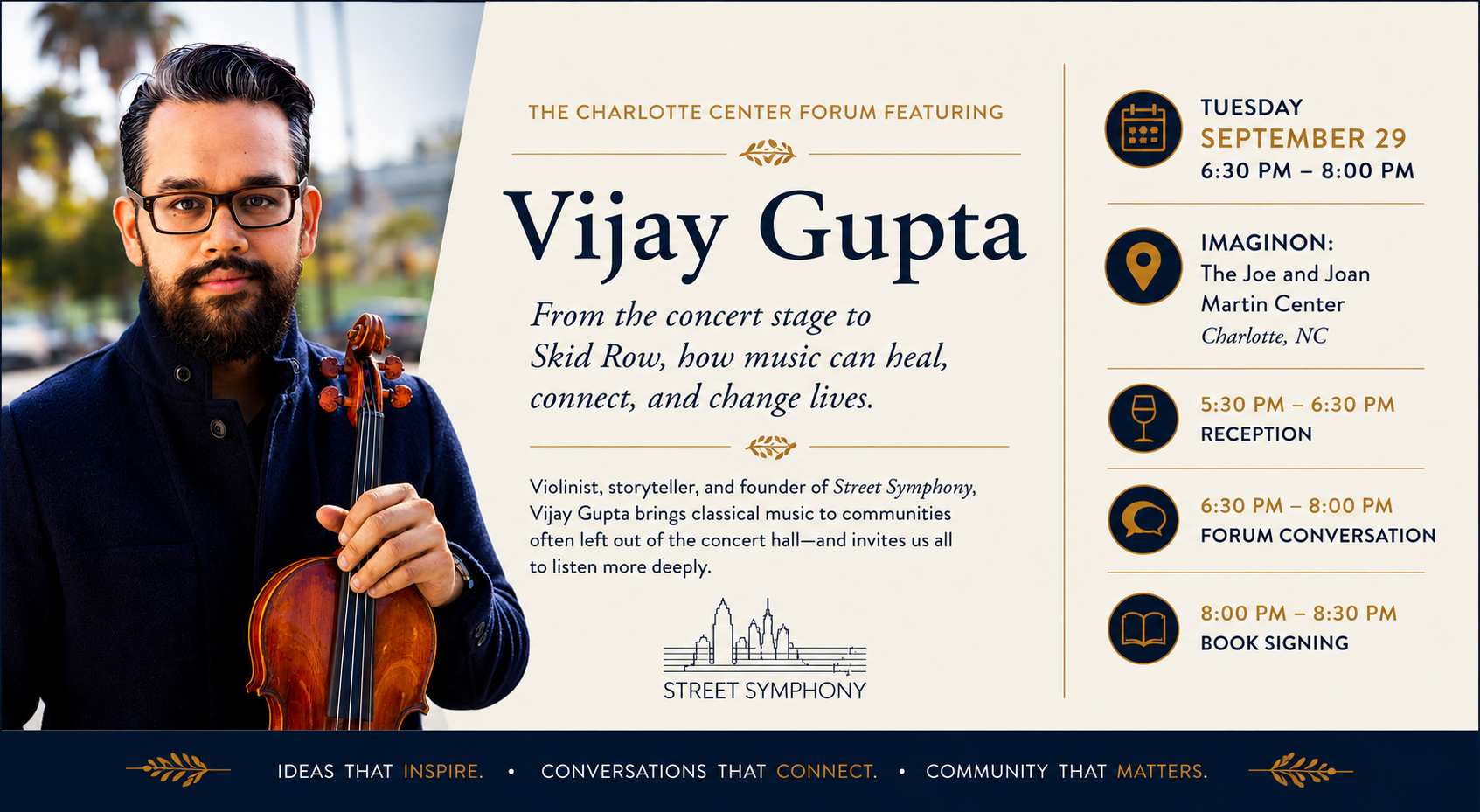
What happens when extraordinary talent becomes a form of service?
On September 29, we welcome Vijay Gupta to The Charlotte Center Forum. A violin prodigy who joined the Los Angeles Philharmonic at just nineteen, Vijay might easily have spent his life on the world's great concert stages. Instead, he began asking a different question: Who are we not playing for? That question led him to found Street Symphony, bringing professional musicians into shelters, jails, clinics, and communities across Los Angeles's Skid Row—not simply to perform, but to build relationships through music.
Vijay's remarkable journey has taken him through neuroscience labs at Harvard Medical School, the Los Angeles Philharmonic, a MacArthur 'Genius' Fellowship, and more than 3,000 Street Symphony performances and workshops. Through it all runs a conviction beautifully suited to our own mission: that art can restore dignity, create belonging, and remind us of our shared humanity.
Join us at ImaginOn for an evening about music, purpose, healing, justice—and what can happen when we offer our gifts in service to one another. Oh, and connection and conversation too! | |
|
|
Before neuroscientist of the mind Heather Berlin took the Forum stage at the Mint Museum last November, we began the evening exploring the human heart. Violinist Lenora Leggatt and cellist Jeremy Lamb, performing on behalf of 7th Street Concerts, played the third movement of Jessie Montgomery’s Duo for Violin and Cello—a spirited contemporary work that reminded us why we love bringing the arts and ideas into the same room.
It was one of those moments when the audience grew quiet, attention gathered, and a Tuesday evening began to feel like something more. If you were there, we hope this clip brings some of that feeling back. If you weren’t, take a few minutes to listen—and perhaps you’ll understand why a Charlotte Center Forum is about more than the person at the microphone. |
|
|
|
Ode to a Plastic Folding Table
By Kathie Collins |
No beauty herself, she seems happy
to support the making of it. She bears the weight of process, welcoming mess.
Praise be her blazoned flesh- streaked with acrylic paints, reds & purples,
keloids raised from grime-encrusted glue. Pencil-etched tributaries flowing into pools
of muddy shellac. She is a relief map, chart of creative strife-embedded
with tear salt, survivor of Exacto assault by some muse-abandoned soul who dragged
a blade deep into her dimpled skin along a river of spilled coffee. I know such
desperation, the desire to carve below the surface into meat, to drag something real, kicking
and screaming, into the world. How I wish I knew her secrets, possessed her tolerance,
humility-the ability to take it all without complaint, then let it go, gather
my legs beneath me, fold my body in half- elegant crane at rest upon an empty nest. |
Kathie Collins is a poet and mythologist, and co-founder and artistic director of Charlotte Lit and editor-in-chief of Charlotte Lit Press.
We're grateful for our partnership with Charlotte Lit and for their devoted work advancing the literary arts. |
|
|
|
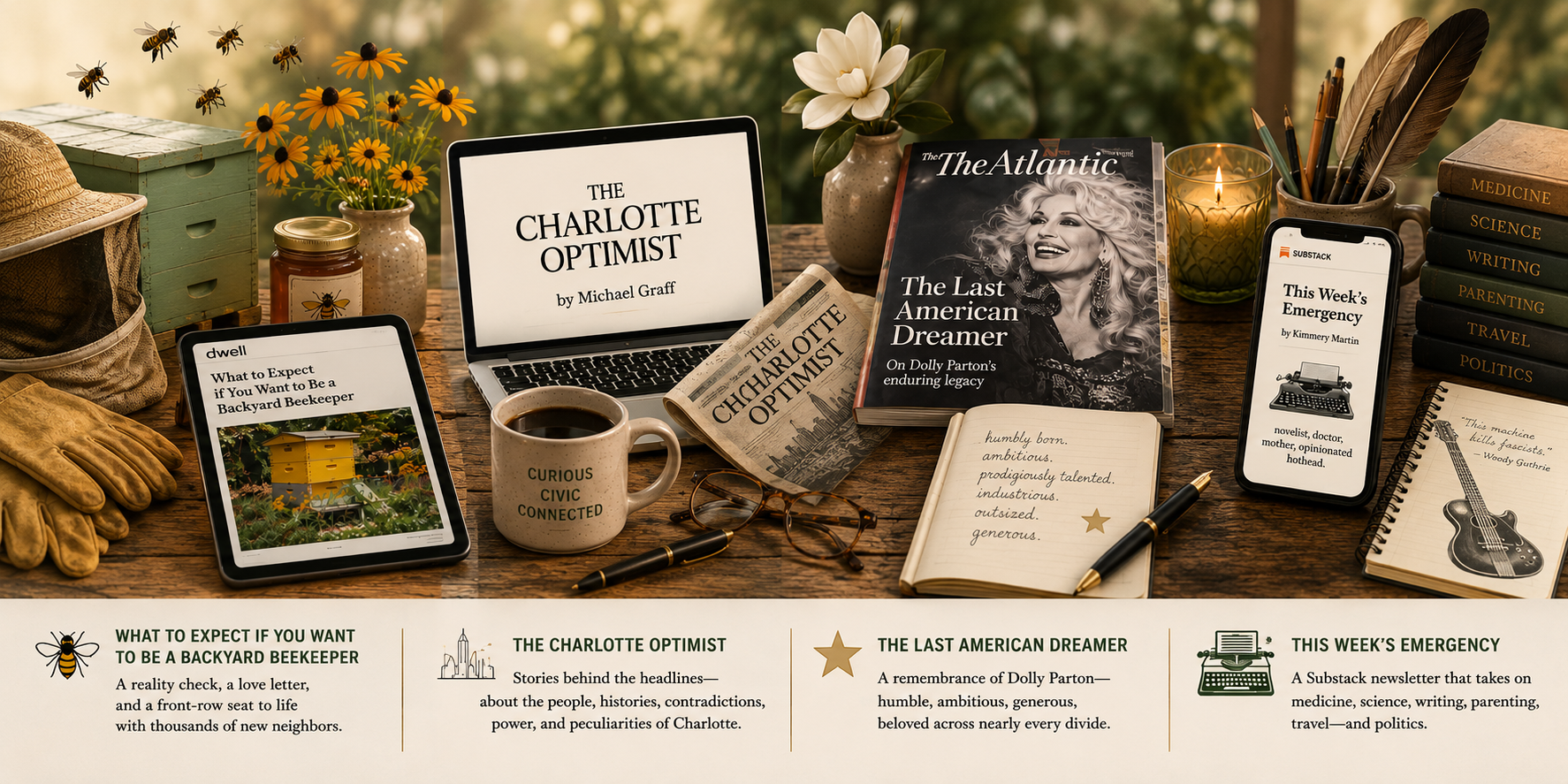
A few things capturing our attention that you might terrific too:
What to Expect if You Want to be a Backyard Beekeeper - Lila Allen, once editor of Charlotte Viewpoint and now founder of the wonderfully idiosyncratic design publication Wrong House, takes up backyard beekeeping with equal parts curiosity and reality check. Come for the dream of homegrown honey; stay for the mites, heavy lifting, thousands of new neighbors—and the possibility that you, too, might fall unexpectedly in love with bees.
The Charlotte Optimist — Michael Graff, who is part Upton Sinclair, part Mark Twain, goes behind the headlines to reveal the people, histories, contradictions, power, and peculiarities of Charlotte as only he can. The Sunday night column is an indispensable immersive read of finely-crafted long-form journalism and story.
The Last American Dreamer — I scrolled for hours on hearing the news about Dolly Parton. The Atlantic’s Annie Joy Williams offers a remembrance of Dolly who remained beloved across nearly every American divide. Dolly embodied the mythology of the nation: humble origins, ambitious, prodigiously talented, industrious, outsized, generous. Feeling her loss is feeling the loss of the best of America.
This Week's Emergency — a heartfelt, morally centered, powerfully convicted Substack newsletter by Kimmery Martin — self-described "novelist, doctor, mother, opinionated hothead." I'd say, brilliantly incisive. Kimmery takes on medicine, science, writing, the publishing industry, parenting, and travel. And just like Woody Guthrie's guitar, she takes on bullies too.
What's brave and beautiful that’s caught your attention?
Here's one more for good measure: I Do the Rock — an absolute singular time-capsule of a song by Tim Curry from his 1979 album Fearless. The perfect album title for his courageous-charismatic-campy-committed oh-so-memorable career. |
|
|
|
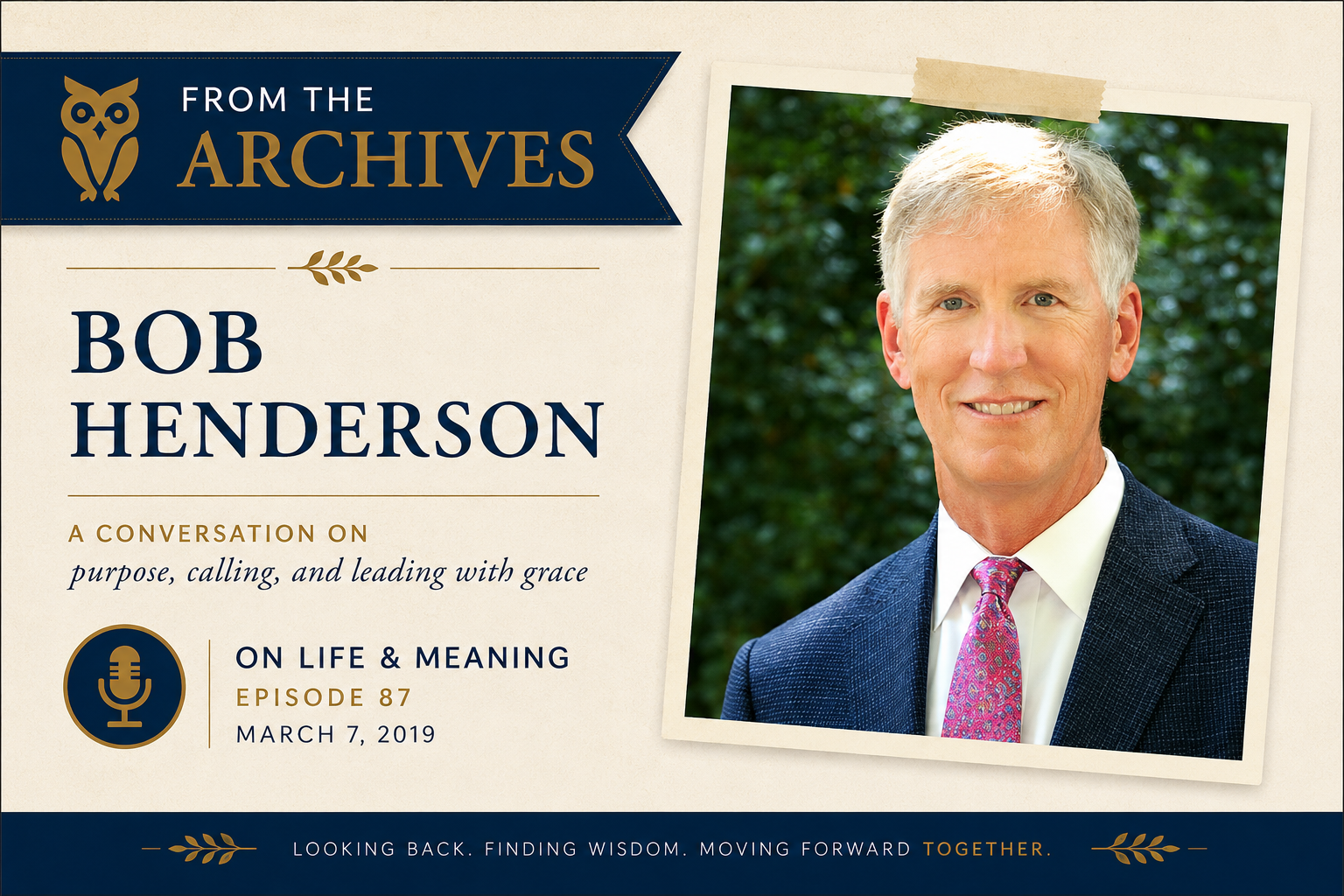
Every month in The Owl, we will bring you a conversation from the archive.
As Senior Minister Bob Henderson prepares to retire from Covenant Presbyterian Church, we return to a conversation from On Life & Meaning that feels especially worth hearing again. When we sat down on March 7, 2019, Bob was already a longtime minister and thoughtful presence in Charlotte’s civic life. Our conversation, titled “Teaching Elder,” ranged widely from Presbyterianism and faith in public life, the authority of scripture, to the ways his own thinking had changed over the course of his ministry.
What stayed with me, though, was the personal journey beneath those larger questions. Bob spoke about what he learned from his parents, a crisis of faith during college, his theological formation, his early years as a minister, and the questions that continued to accompany him at mid-career. We ended with one of the simplest and hardest questions I asked my guests: What do you know is true? Seven years later, as Bob approaches another threshold, the conversation offers an opportunity not simply to look back on a distinguished ministry, but to consider how a life of conviction can remain open to reflection, change, uncertainty, and grace. That seems a fitting conversation to revisit now. | |
|
|
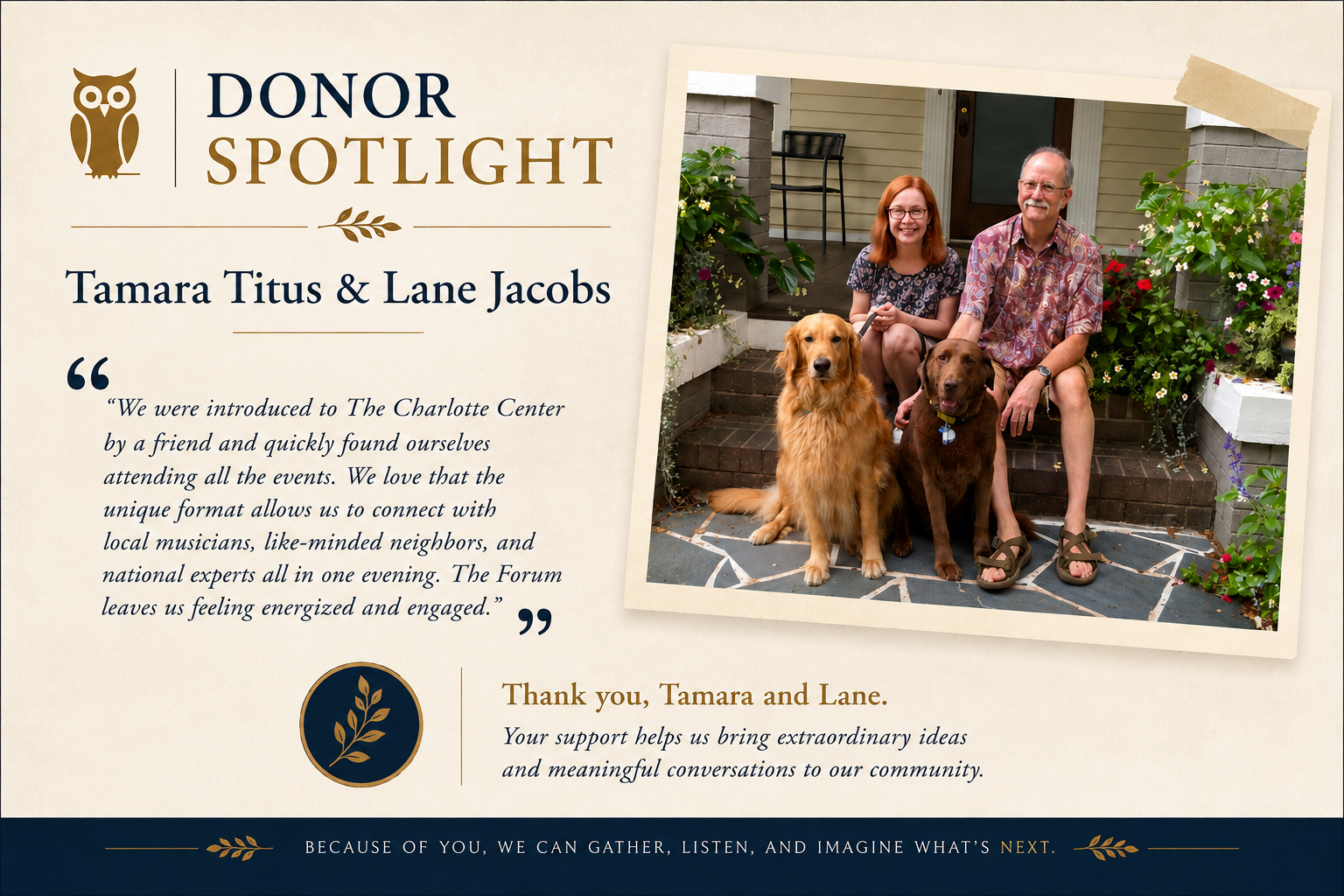
The Charlotte Center has grown largely through friendship: one person comes to a Forum, brings someone else the next time, and before long, familiar faces become part of the community. Tamara Titus and Lane Jacobs came to us just that way.
Longtime Dilworth residents, Tamara and Lane have each contributed to Charlotte in different ways. Tamara is a writer and longtime advocate for historic preservation. Lane recently retired from Atrium Health after three decades as a clinical professor of Internal Medicine. And, as you'll gather from the photograph, their household includes pups Briar and Riley.
Tamara and Lane shared: “We were introduced to The Charlotte Center by a friend and quickly found ourselves attending all the events. We love that the unique format allows us to connect with local musicians, like-minded neighbors, and national experts all in one evening. The Forum leaves us feeling energized and engaged.”
We couldn't ask for a better description of what we hope happens at a Forum. We're grateful that Tamara and Lane found their way to us—and that they've chosen to help make these gatherings possible for others. |
|
|
|
This is why we gather.
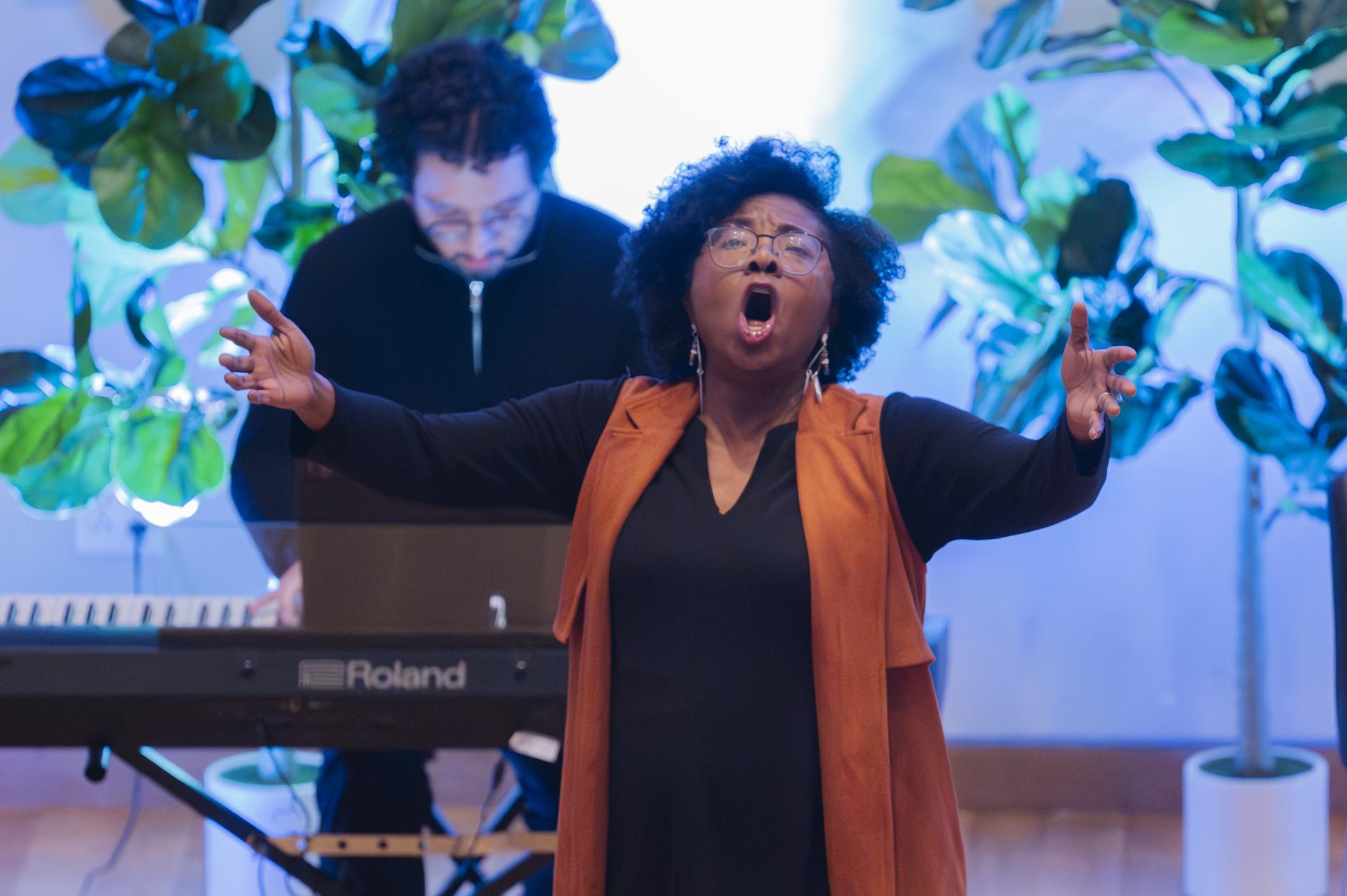
There are moments at Charlotte Center events that are difficult to put into a mission statement. A singer opens her arms and fills a room with music. A speaker says something that makes an audience laugh, reconsider, or lean forward. Strangers strike up conversations. Someone stays afterward because they're not quite ready for the evening to end. These are small things, perhaps. But we think they matter.
The Charlotte Center exists to create more of them: moments when ideas become conversation, art becomes connection, and a roomful of people becomes, for a little while, a community. If you believe Charlotte needs more spaces like this, we'd be grateful to have you help us create them. |
|
|
|
Here's a lighter life moment: The trailer to Coyote vs. Acme had my wife and I laughing in stitches enough to watch as many versions of it we could find on our phones as we tucked in for the night. What's not to love about Wile E.? He's irrepressible. Endlessly resilient. A canine for all seasons. We can learn a lot from his dogged optimism.
We make plans. They go sideways. We misjudge the distance. Occasionally, we realize we've run several feet beyond the edge of a cliff and haven't yet looked down. And still, somehow, we begin again. Giving the Road Runner one more shot. Laura and I went to sleep laughing (after the tears about Dolly). We have a Saturday night date at the movies. --- Let us know what you think about this second issue. Reach us at thecharlottecenter@gmail.com. |
|
|
|
Thank you to all of our generous donors and sponsors that make our work possible. |
Never miss an email from The Charlotte Center! Please add thecharlottecenter@gmail.com to your Safe Senders list. Be sure to check your Spam or Junk folders if you don’t see us in your inbox. |
|
|
|
| The Charlotte Center is a non-profit 501(c)3 organization. |
|
|
|
|