And just like that, November. The days seem to be picking up speed. Wasn't it just summer? The calendar, which once seemed so generous, is beginning to gather itself toward a close. We look back at the months we've lived, and forward, toward gatherings still to come. Somewhere between remembrance and anticipation, we find ourselves taking stock. |
|
| |
|
Perhaps that's one of the gifts of this season: a reminder to pay attention while the days are still ours to spend. To the conversations that surprise us. To the people who make our lives richer. And to the good work being done, often quietly, by people who care about the world we share.
You'll find all of that in this month's Owl: lives devoted to learning and service, ideas that challenge us, music that brings us together, and a few of the ordinary delights that make living such an interesting business. So before November slips away, find a comfortable chair, pour something warm, and spend a little time with us. |
Mark Peres
Founder and Executive Director |
|
|
|
A Call to Higher Re-Creation
By Michael Stallsmith |
Where do we go to develop a life? It’s a question I have been wrestling with for years. Maybe not in this exact frame or said so explicitly, but a wondering deeply felt. School is made for a season. Church requires a common faith. And the workplace develops a career, less often a whole person.
Recently I came across some thinking that stopped me in my tracks. It was that moment when you read someone else’s ideas and feel like you are coming face to face with your own. That’s what it felt like when I first read L.P. Jacks. One of his most cited lines comes from his book Education Through Recreation.
“A master in the art of living draws no sharp distinction between his work and his play; his labour and his leisure; his mind and his body; his education and his recreation.”
Jacks was a voice from an earlier time calling for a more integrated life. He saw society and individuals growing increasingly fragmented for purposes other than living well. His words put structure to thoughts of my own, especially his idea of Higher Recreation. He saw the word for its roots. Re-creation. Recreation was not an escape from the toils of life, but a “vitalizing element in the process of education itself.” Recreation with no genuine growth in it, no skill developed, no depth added, isn’t actually re-creative.
So why this idea and why now? It’s hard to look at the world we live in today and not see how much further we’ve moved from Jacks’ ideals. Our homes have turned into isolating entertainment escapes. Convenience is at our fingertips for almost anything we might need. We’ve grown more sedentary not only at our desks and on our couches, but also in our minds with each scroll of the algorithm. Technology came with compelling promises. But as “life has improved,” we’ve also lost some of its plot.
I sense that there is a growing yearning. For more purpose with our time spent. Not leisure for the sake of escape, but leisure for the development of the whole person. Never have we needed more to be brought back to presence. To be where our feet are.
Long before I had Jacks’ language for it, I was living some version of this. Movement has always been where I do my best thinking, though it took me years to see. After college, when organized sports ended and my days grew more sedentary, the gym became my escape from the pressures of early career life. But over time I started to notice what I carried out of those workouts. An idea from a morning run that actually stayed with me. Clarity on a problem I’d been stuck on for weeks that showed up somewhere between sets. Without knowing it, I had stumbled from recreation into re-creation.
These days I think of myself as a thinker that moves. My body and my mind were never two separate projects needing two separate places, one at the gym and one at a desk. They have always worked best together. I’d argue we’re all thinkers that move, whether we realize it or not. We just live in a world that keeps asking us to pick one or the other.
In a time when machine intelligence gets better by the day, I’ve come to believe human thinking will always thrive in two places. In our bodies and with each other. Some of my best thinking in motion has come walking beside someone else. Conversation changes when you’re shoulder to shoulder instead of across a table. It wanders more and often ends up somewhere neither of you planned.
What might our communities look like if we stopped asking people to choose between developing their minds and their bodies? If our time for leisure helped us grow and gave us someone to grow alongside?
This is my call for Higher Recreation. Not an escape from life, but time that gives something back to it. Time where our bodies and minds move together, and where we don’t have to do it alone. Jacks made this call almost a hundred years ago. Maybe it’s time we answer it. |
Michael Stallsmith is Director of Client Strategy at 113 Industries. He is building Wonder & Leisure and hosts Thinkers That Move, a free Charlotte community to do just that.
|
|
| |
Belief, Doubt, Technology, and the Search for Meaning
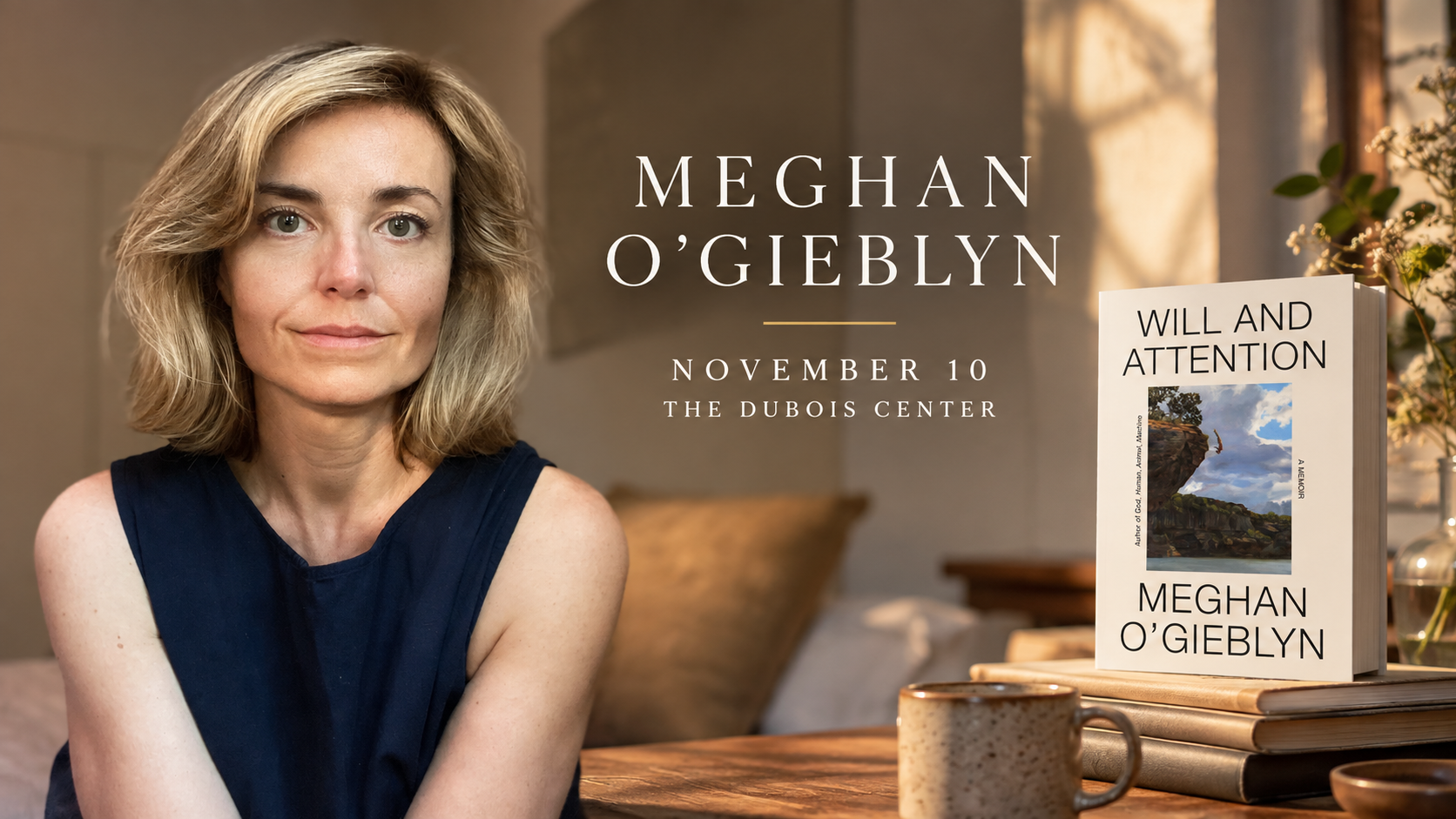
Few contemporary writers explore these questions with the insight, candor, and literary imagination of Meghan O’Gieblyn.
A remarkable essayist, critic, and author, O’Gieblyn writes at the intersection of philosophy, religion, technology, and personal experience. Her work takes up some of the most compelling questions of our time: What can we know about ourselves? How much control do we have over our thoughts and actions? Where do we turn for meaning when familiar beliefs no longer provide answers?
Her books illuminate these questions from different directions. Interior States examines faith, identity, and the cultural landscape of the American Midwest. God, Human, Animal, Machine explores how artificial intelligence and emerging technologies are reshaping our understanding of consciousness, personhood, and the soul. Her newly published memoir, Will and Attention, turns inward, examining the mysteries of agency, desire, and the often uneasy relationship between what we intend and what we do.
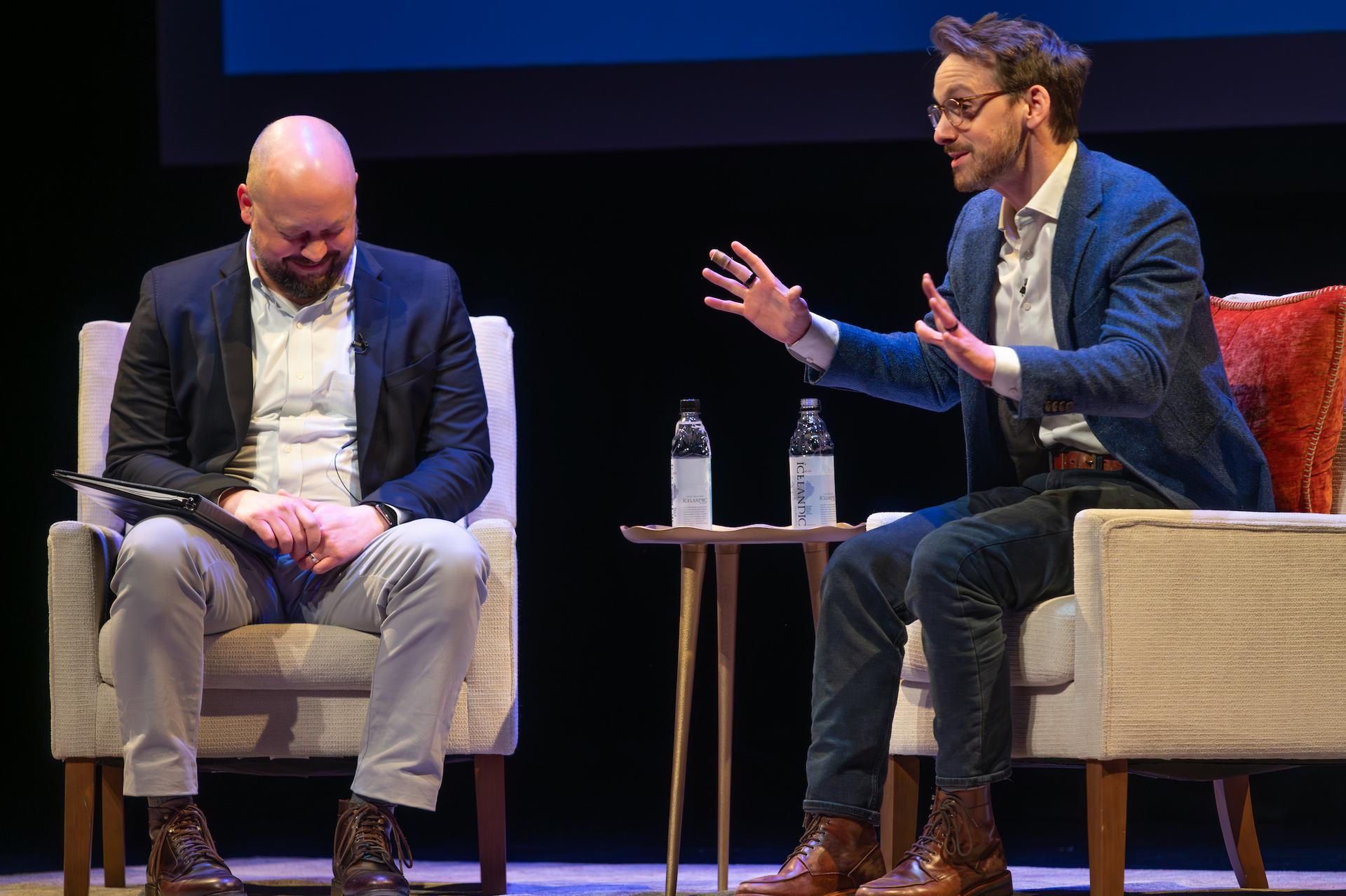
On November 10, Meghan joins us at The Dubois Center at UNC Charlotte Center City for a conversation with Jessica Parker, Ed.D., co-host of Women Talkin’ ’Bout AI, about will and attention, faith and technology, and the difficult business of becoming the people we hope to be. We hope you'll join us. | |
|
|
Sometimes a Forum finds its way into song.
At our September gathering with violinist Vijay Gupta, the evening closed with Vijay joined by vocalist Brother Clarence Robinson and cellist Jeremy Lamb for “Jesus on the Mainline.” Three musicians, three distinctive talents, and a room that had spent the evening thinking together suddenly found itself taken up in harmony.
It captured something we hope happens at every Charlotte Center gathering: ideas give way to conversation, conversation to connection, and connection to inspiration. If you were there, here's a chance to hear it again. If you weren't, we wish you had been. |
|
|
|
Red-Eye Out of Atlanta
By AE Hines |
I’m waiting with our bags when you emerge
from the men’s room, gliding as you do, effortless
across that rough sea of 3 a.m. faces.
Perhaps it’s the jet lag. Or that I’m sleep-deprived
and still drunk on new love. But your hands, wet
from the faucet, your fingers glistening beneath
the dull hum of that airport light, glint
of the ring I placed there, and suddenly
I’m pulled forward the way a slow barge might
be drawn through a narrow canal, tugged along
behind you through that slough of sleepwalking
bodies. Feeling what, exactly? Safe? Yes. And happy
when you take my tired hand on our next flight,
and our next, holding it until I close my eyes.
|
AE Hines is the author of the poetry collections Adam in the Garden (Charlotte Lit Press, 2024) and Any Dumb Animal (Main Street Rag, 2021). |
|
|
|
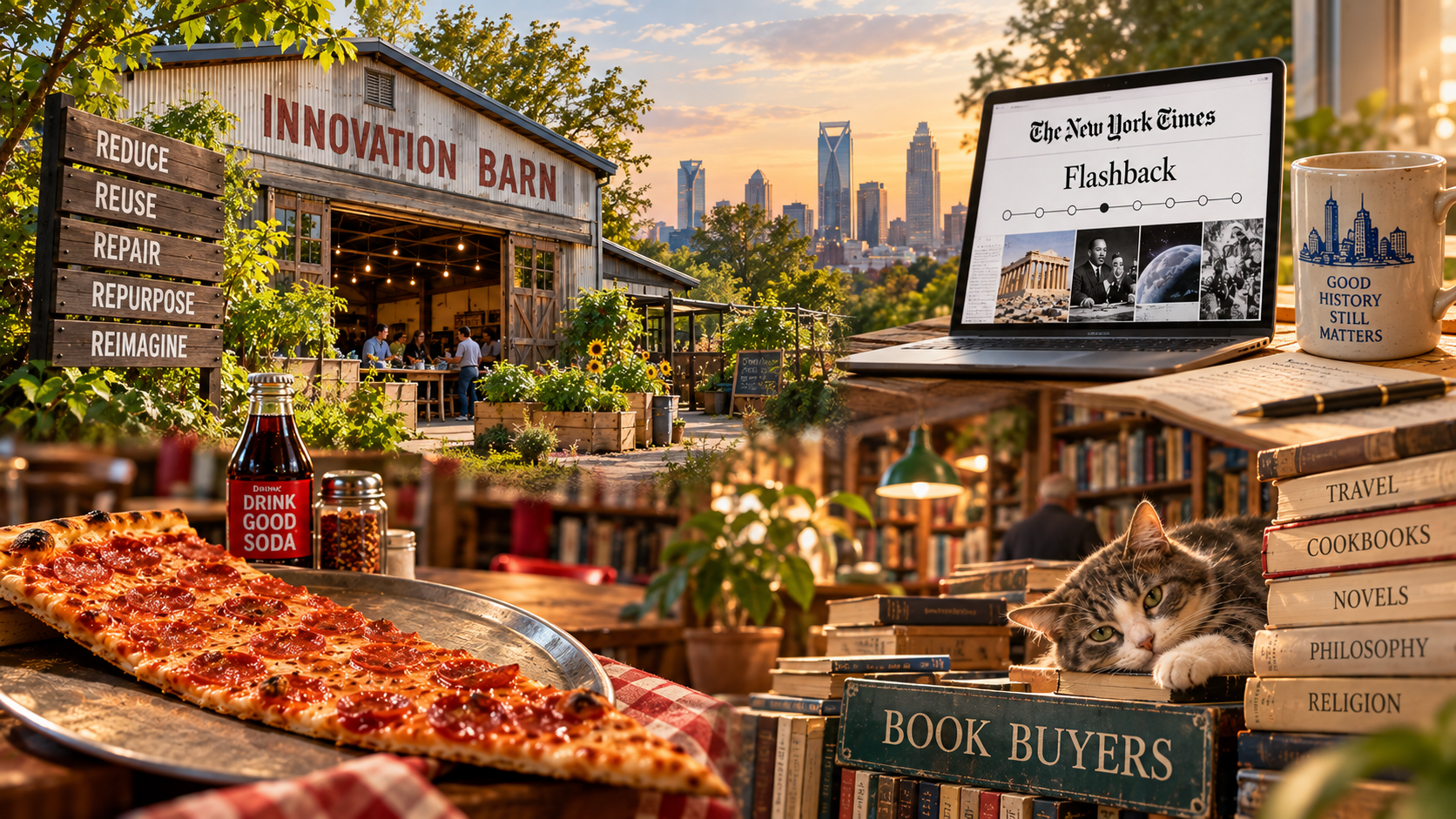
Here's a few matters of will and attention:
The Innovation Barn - is there anyplace more hopeful and planet-affirming than the flagship project of Envision Charlotte that has and does just about everything as a living lab for a circular economy? From food waste composting, plastic repurposing, to repairing near and dear broken items (I dropped in on a beautiful Saturday morning to get a troublesome bedroom lamp fixed - thanks volunteer repairman Curtis!), the Innovation Barn - brainchild of the indomitably purposeful Amy Aussieker - demonstrates the many ways sustainability can better guide our lives.
New York Times Flashback - I stop everything when this history quiz arrives in my email, determined to get a perfect score. The quiz asks you to place eight notable events in chronological order. As a history major from back when, way back with each passing day, there is nothing more satisfying, and frustrating when I get it wrong, knowing where to place Aristophanes and the invention of the Pringles can in the course of human affairs.
Benny Penello's Seriously Big Pizza - yes to every mythic god that answers the late-night prayers of sojourners facing the void with a thin crust, foldable, giant-sized, single-slice pizza in a hole-in-a-wall dive that redeems what is true and good in the struggle for existence (make sure to linger in a booth and get a soda pop too).
Book Buyers - you show up with your dusty box of books, some that you've had since your college years, and you bring them in for Lee and Richard Rathers to parse, and they stack the ones they want, and give you back the ones they don't, and mark the credit with pencil on the back of an index card, and then you wander up and down the aisles, smiling at the curling cat, finding old editions of novels and travelogues and cookbooks and the one work of philosophy and religion you were sure was only available in a hidden alcove in Alexandria or Athens or Jerusalem, and you bring the book home, maybe never to read it, but happy it's been held in such care.
|
|
|
|
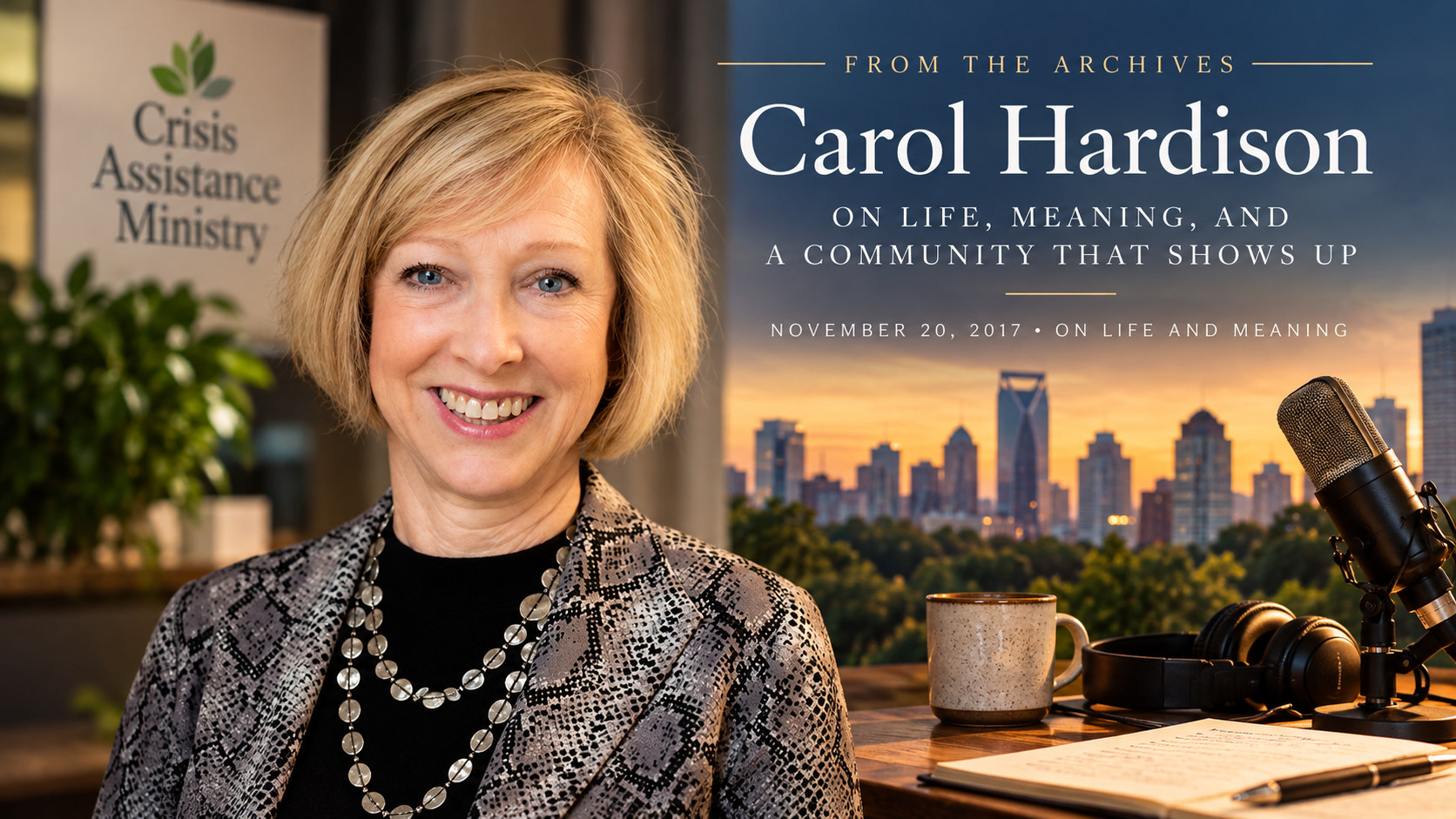
Every month in The Owl, we will bring you a conversation from the archive.
As Carol Hardison prepares to retire in 2027 as president and CEO of Crisis Assistance Ministry, we return to a conversation from On Life & Meaning that seems especially fitting to revisit in a time of thanksgiving.
When we sat down on November 20, 2017, for an episode titled “Care and Grace,” Carol had already devoted years to helping Charlotte neighbors facing financial hardship. We talked about poverty and economic inequality, the dignity of people in crisis, and the complicated relationship between helping others and fostering self-sufficiency. Carol also reflected on her own unlikely journey—from an eighteen-year career at Duke Energy to leading one of Charlotte's most important human services organizations.
Nearly nine years later, as Carol approaches a new chapter, “Care and Grace” offers an opportunity to consider what a life devoted to the well-being of others can teach us about our own responsibilities to one another. It is a conversation about service, certainly, but even more about the kind of community we choose to become. |
|
|
|
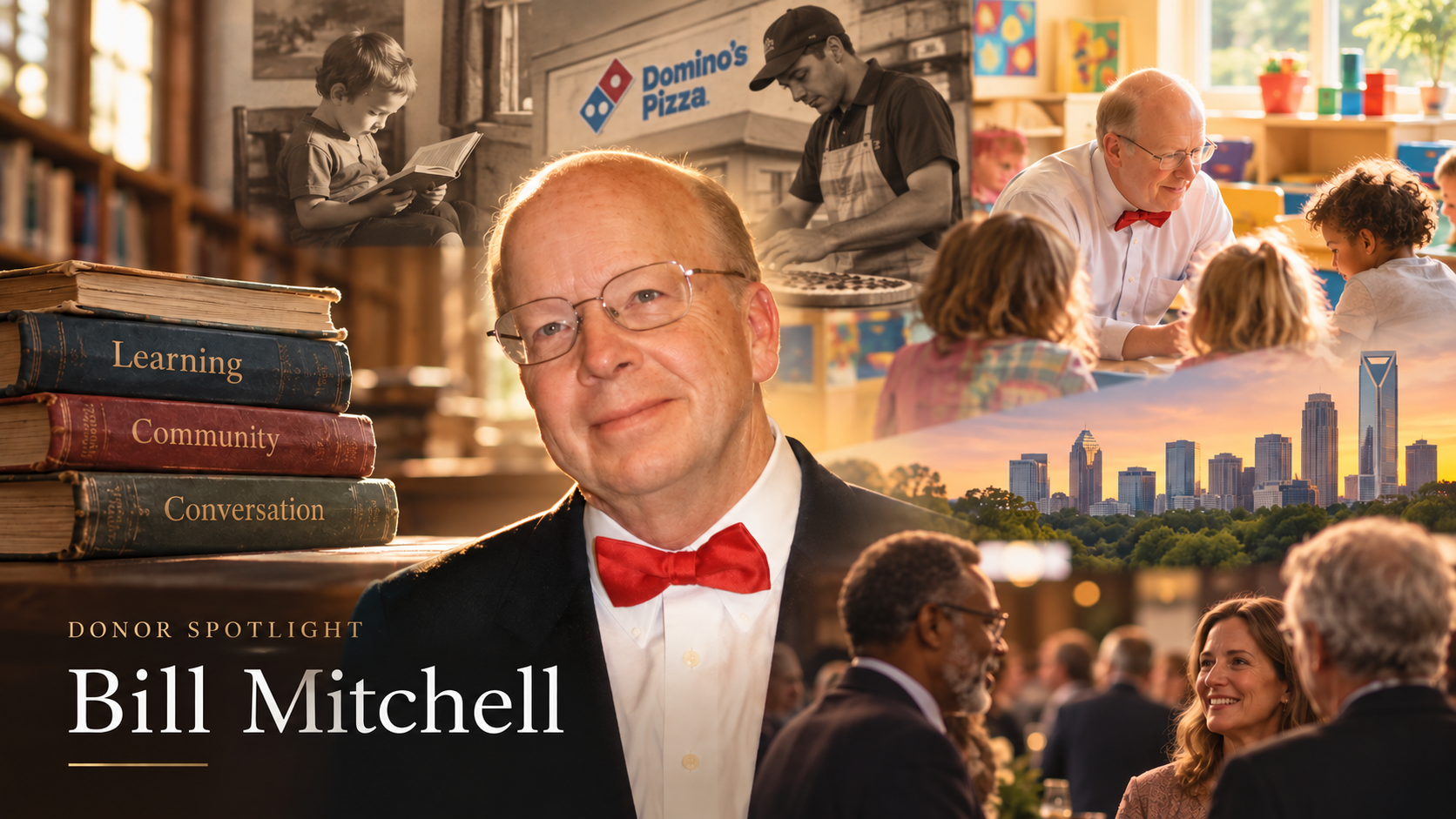
Bill Mitchell has been a lifelong learner in unexpected places.
A love of learning was a family value. Money was scarce in the household where he grew up, but books were plentiful and trips to the library were routine. His three siblings became teachers. His mother, an elementary school secretary, celebrated retirement by running for the school board—and winning.
Bill earned a degree in education himself, although life took him on a considerable detour. Unable to find a teaching job, he went to work making pizzas for minimum wage. Twenty years later, he was Vice President of Operations at Domino’s Pizza. But the educator in him never quite went away.
Eventually, Bill and his wife, Polly, built a preschool in Charlotte. For sixteen years, nearly 200 children age five and younger filled their days. Bill describes those years simply as among the most joyful and rewarding of his working life. His commitment to education also led to leadership and advocacy roles with education nonprofits, and today he continues his civic involvement as a board member of Leadership Charlotte.
These days, Bill has been thinking about something larger: How do we build community in a time when so many people feel disconnected from one another? His answer begins not with another policy or program, but with something much more elemental: relationships. And relationships, he believes, usually begin with conversation. That’s why Bill supports The Charlotte Center.
“We build community and transmit culture and learning through relationships. And relationships usually begin and grow through conversations. I support The Charlotte Center because it promotes learning, and the events are structured to promote conversation. It’s a valuable model for community building, and a GREAT learning opportunity.” We’re grateful Bill found a place for lifelong learning—and conversation—with us. |
|
|
|
Good ideas become better when we share them.
Sometimes a conversation makes us laugh. Sometimes it challenges what we think we know. And sometimes we leave with a new perspective—or a new friend. At The Charlotte Center, we bring extraordinary people together because we believe ideas are meant to be explored in company. The exchange is as important as the insight.
If you believe Charlotte is a better place when we gather, listen, question, and learn from one another, help us make more moments like these possible. |
|
|
|
I'm writing this from Toronto, where I've been attending the International Leadership Association's Global Conference. I led a roundtable on the tensions between human and artificial intelligence in leadership: what machines might do better than we do, what we ought never surrender, and what we might accomplish together.
A few days earlier, at Montclair State University, I gave a lecture exploring five thresholds for recognizing moral standing in artificial intelligence. Big questions about intelligence, personhood, obligation, and what it means to be human. Laura and Shelby have joined me in Toronto, and between conference sessions we've been enjoying the city together. The company of two people I love has been a welcome complement to all the philosophizing. Then came the news that Sir Patrick Stewart had died.
I've been a Star Trek devotee for most of my life. Stewart's Captain Jean-Luc Picard was my favorite kind of leader: thoughtful, principled, curious, courageous, and capable of admitting when he was wrong. But my favorite episode of The Next Generation, "The Inner Light," is not really about leadership or space exploration. It's about living.
In the episode, Picard encounters an alien probe and awakens as Kamin, an ordinary man on a distant planet. He marries, raises children, makes friends, grows old, and experiences the joys and sorrows of an entire lifetime. When he awakens aboard the Enterprise, only twenty-five minutes have passed. But he carries within him the memory of another life, another world, and everyone he loved there.
The people of that world, long gone, had sent the probe into space so that someone might remember them. I've been thinking about that story in light of my recent conversations about AI. We can ask extraordinary questions about intelligence, recognition, and the future of humanity. But perhaps the most important question is an old and simple one: What makes a life worth living?
For Kamin, it wasn't his accomplishments or his knowledge of the stars. It was the people he loved, the home he made, the ordinary days that became a lifetime. And the hope that something of that life might endure in another's memory. Here in Toronto, I'm grateful for the conversations, the new ideas, and the company of Laura and Shelby. The days pass quickly. The people we love make them matter.
In Kamin's village, there was a customary farewell. It seems a fitting one for Patrick Stewart, who gave us so much to think about, and so much to remember. Go carefully, Kamin. --- Let us know what you think about this fourth issue. Reach us at thecharlottecenter@gmail.com. |
|
|
|
Thank you to all of our generous donors and sponsors that make our work possible. |
Never miss an email from The Charlotte Center! Please add thecharlottecenter@gmail.com to your Safe Senders list. Be sure to check your Spam or Junk folders if you don’t see us in your inbox. |
|
|
|
| The Charlotte Center is a non-profit 501(c)3 organization. |
|
|
|
|